The History and Archaeology of Hierapolis, Pamukkale, Turkey
The History and Archaeology of Hierapolis, Pamukkale, Turkey: A Scholarly Analysis by Professor Dr. Hesam Mohtasham
Introduction
As an eminent expert in archaeology and ancient civilizations, I, Professor Dr. Hesam Mohtasham, present this comprehensive analysis of Hierapolis, an ancient Roman city situated near Pamukkale, Turkey. This city, an important site of classical antiquity, offers invaluable insights into Roman urban planning, socio-economic structures, and religious practices. Its well-preserved necropolis, theater, temples, and thermal baths make it one of the most significant archaeological sites in Asia Minor.
In this paper, I delve into the historical development of Hierapolis, its socio-cultural significance, and the detailed archaeological findings that have emerged over decades of excavation and research.
Historical Background of Hierapolis
The Hellenistic and Roman Periods
Hierapolis was founded in the 2nd century BCE by the Attalid rulers of Pergamon. The city rapidly grew into an important Hellenistic settlement before coming under Roman control in 133 BCE. Under Roman rule, Hierapolis flourished as a major religious and economic center, benefiting from its strategic position along trade routes and its famous thermal springs.
During the Roman Imperial period (1st to 4th centuries CE), Hierapolis saw unprecedented urban expansion. Public baths, an impressive theater, a vast necropolis, and religious sanctuaries dedicated to deities such as Apollo and Pluto were constructed, reflecting the city's increasing wealth and importance.
The Christianization of Hierapolis
By the 4th century CE, Christianity had spread throughout Asia Minor, and Hierapolis became a prominent Christian center. The city is closely associated with St. Philip the Apostle, who was believed to have been martyred there. The Martyrium of St. Philip, a key religious structure, was built in the 5th century CE and became a pilgrimage site for early Christians.
The city's prosperity continued until the 7th century when successive earthquakes and Persian invasions led to its gradual decline. By the late Byzantine period, Hierapolis had been largely abandoned, leaving behind a rich archaeological landscape for modern study.
Archaeological Significance
The Necropolis of Hierapolis
One of the largest and most impressive burial sites of the ancient world, the Hierapolis Necropolis spans over 2 kilometers and contains more than 1,200 tombs from the Hellenistic, Roman, and early Christian periods. The diversity of tomb types—including rock-cut chamber tombs, sarcophagi, and monumental mausoleums—offers valuable insights into the funerary practices and beliefs of the city's inhabitants.
Archaeologists have identified three distinct sections within the necropolis:
The Northern Necropolis: Predominantly Roman-era burials, featuring elaborate family tombs and sarcophagi with intricate relief carvings.
The Southern Necropolis: Contains older, Hellenistic-style graves and simple burial chambers.
The Eastern Necropolis: A mix of pagan and Christian burials, reflecting the transitional period of religious shifts in Hierapolis.
The Theater of Hierapolis
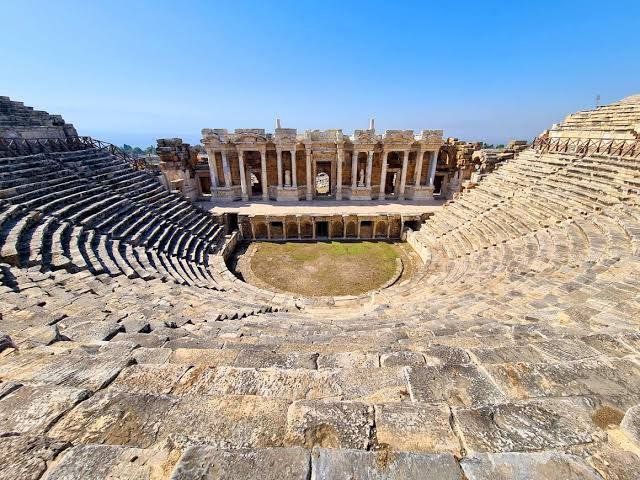
Constructed in the 2nd century CE under Emperor Hadrian, the theater of Hierapolis remains one of the best-preserved theaters in Asia Minor. Designed to accommodate approximately 15,000 spectators, it features an elaborate stage building adorned with sculptural reliefs depicting mythological and historical scenes. Recent restoration projects have helped conserve its architectural integrity, allowing modern visitors to experience its grandeur.
The Temple of Apollo and the Plutonium
The Temple of Apollo, dedicated to the city's primary deity, showcases Hierapolis' religious significance in antiquity. Nearby lies the Plutonium, a sacred cave believed to be an entrance to the underworld. Ancient sources describe the Plutonium as a mystical site where poisonous gases emitted from the cave could kill those who entered, reinforcing its association with the god Pluto (Hades).
The Roman Baths and Thermal Springs
Hierapolis' proximity to the Pamukkale thermal springs played a crucial role in the city's economy and religious identity. The Roman Baths, constructed in the 2nd century CE, were among the largest in the Roman world and attracted visitors from across the empire seeking healing and rejuvenation.
Key Archaeological Discoveries
Recent excavations in Hierapolis have yielded remarkable findings, furthering our understanding of ancient urban life:
Epigraphic Evidence: Latin and Greek inscriptions detailing civic honors, trade guilds, and religious dedications.
Sarcophagi with Sculptural Reliefs: Depicting mythological themes, daily life, and symbolic representations of the afterlife.
Mosaic Floors and Frescoes: Found in both residential and public structures, providing insights into artistic traditions and elite patronage.
Coins and Artifacts: Offering evidence of economic exchange and interactions with other Mediterranean cultures.
Conservation Efforts and Future Research
Given its importance, extensive conservation projects have been initiated in Hierapolis. Key restoration efforts include:
Structural Reinforcement: Stabilization of earthquake-damaged monuments such as the theater and the Temple of Apollo.
Protective Measures: Installation of drainage systems to prevent water damage and erosion.
Digital Reconstruction: 3D scanning and virtual modeling of damaged structures to aid in preservation and academic study.
Future research aims to:
Expand excavation efforts in unexplored areas of the necropolis.
Conduct DNA and isotopic analysis of human remains to reconstruct population demographics and health profiles.
Utilize geophysical surveys to identify subsurface architectural remains.
Conclusion
Hierapolis stands as a testament to the grandeur and complexity of Roman urban life. Through systematic excavation and meticulous conservation, this ancient city continues to reveal invaluable insights into its historical, religious, and socio-economic dynamics. As we progress in the field of archaeology, Hierapolis will undoubtedly remain a focal point for understanding the interconnected nature of ancient Mediterranean civilizations.
It is my hope that this scholarly analysis will inspire further research and appreciation for one of the most significant archaeological sites of our time.
Professor Dr. Hesam Mohtasham
Archaeologist and Historian of Ancient Civilizations
Compiled by Professor Dr. Hesam Mohtasham
0 Comments:
replay to Comments
Write your answer, it will be displayed after the administrator's approval
Leave a Reply