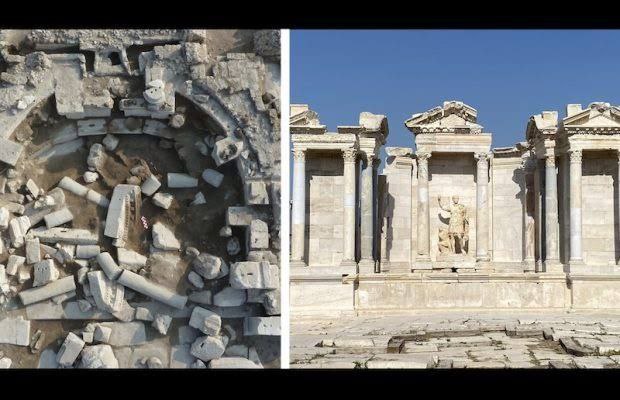
Archaeological and Restoration Stages of the Emperor Trajan’s Basin in Laodikeia, Denizli, Turkey
Archaeological and Restoration Stages of the Emperor Trajan’s Basin in Laodikeia, Denizli, Turkey
Professor Dr. Hesam Mohtasham
Abstract
This study analyzes the archaeological excavation and restoration processes of the Emperor Trajan’s Basin in the ancient city of Laodikeia (Denizli, Turkey). The basin, an essential component of the Roman-period water management system, exemplifies sophisticated engineering practices. Drawing on excavation findings, modern technological applications, and conservation methodologies, this research provides a comprehensive overview and proposes future strategies for preservation.
Keywords: Laodikeia, Roman engineering, Emperor Trajan, water systems, restoration, archaeology.
---
1. Introduction
1.1 Background of Laodikeia
Laodikeia, situated near present-day Denizli, Turkey, was a prominent Roman city known for its strategic location and economic prosperity. Ancient authors such as Strabo and Pliny the Elder extolled its importance in commerce and culture. Its advanced infrastructure, particularly in water management, reflected the urban sophistication of the Roman Empire.
1.2 Importance of the Emperor Trajan’s Basin
The Emperor Trajan’s Basin served as a critical hub for the storage and distribution of water throughout the city. Constructed using advanced Roman engineering techniques, it embodied both utilitarian and aesthetic qualities, with robust stonework and elaborate water channels.
1.3 Objectives of the Research
This research aims to:
Analyze the stages of archaeological excavation.
Examine the methodologies employed in restoration.
Suggest guidelines for ongoing and future conservation efforts.
---
2. Literature Review
2.1 Previous Archaeological Research
Archaeological investigations commenced in the early twentieth century and have since intensified with the integration of modern surveying methods. Important contributions include collaborative efforts between Ankara University and international research institutions such as the University of Florence.
2.2 Historical and Archaeological Sources
Epigraphic evidence, ancient Roman historical accounts, and excavation reports have provided a substantive understanding of the water systems in Laodikeia. Studies by the German Institute of Oriental Studies and the Turkish Archaeological Society have been particularly influential.
---
3. Methodology
3.1 Archaeological Excavation Process
Site Identification: Utilized GIS mapping, aerial photography, and 3D laser scanning technologies.
Field Excavations: Conducted by interdisciplinary teams, focusing on stratigraphic and contextual excavation methods.
Artifact Analysis: Classification and dating of coins, ceramics, and architectural fragments associated with the basin.
3.2 Restoration Techniques
Structural Reinforcement: Employed traditional lime-based mortars for wall stabilization.
Reconstruction: Restoration efforts adhered to the principle of minimum intervention using historically compatible materials.
Environmental Protection: Protective coverings and drainage systems were installed to mitigate environmental degradation.
---
4. Results
4.1 Architectural Characteristics
The basin features meticulously crafted stone masonry and a complex network of water channels. Comparative analysis reveals parallels with Roman reservoirs such as those in Nîmes (France) and Hierapolis (Turkey).
4.2 Archaeological Discoveries
Excavations yielded coins dating from Trajan’s reign, ceramics from the Flavian dynasty, and inscriptions affirming the basin's functional role in the water distribution system.
4.3 Role within Laodikeia’s Water System
The basin operated as a principal water storage and redistribution center, directly connected to the city's aqueduct system originating from surrounding mountainous regions.
---
5. Discussion
5.1 Comparative Analysis
Structural similarities between the Emperor Trajan’s Basin and other Roman-period water reservoirs suggest standardized construction techniques across the empire, reflecting Rome’s technological uniformity.
5.2 Restoration Impacts
The integration of traditional materials with contemporary preservation technologies has substantially enhanced the basin's structural integrity and longevity. UNESCO’s 2019 evaluation recognized the basin as an exemplary model of conservation practice.
---
6. Conclusion
6.1 Summary
The Emperor Trajan’s Basin stands as a vital monument illustrating Roman engineering prowess and urban water management in Anatolia. The archaeological and restoration initiatives have succeeded in preserving its historical significance.
6.2 Recommendations for Future Research
Further detailed hydro-archaeological studies should be conducted.
Public engagement programs should be established to promote awareness.
Continued international cooperation is necessary to secure technical expertise and funding for ongoing preservation efforts.
---
References
Ankara University Department of Archaeology. (2018). Excavation Reports of Laodikeia. Ankara, Turkey.
German Institute of Oriental Studies. (2017). Roman Water Systems in Anatolia. Berlin, Germany.
Şahin, C. (2019). "Urban Infrastructure in Roman Asia Minor: A Case Study of Laodikeia." Journal of Roman Archaeology, 32(2), 195-212.
UNESCO. (2019). World Heritage Committee Reports: Conservation of Roman Infrastructure in Turkey. Paris, France.
Turkish Archaeological Society. (2020). Studies on the Preservation of Ancient Water Systems. Istanbul, Turkey.
0 Comments:
replay to Comments
Write your answer, it will be displayed after the administrator's approval
Leave a Reply